
How the abandoned Kamaoa site became a warning for every aging wind farm
At Hawaii's remote South Point, rusting wind turbines once loomed like skeletons on the landscape. The abandoned Kamaoa Wind Farm stood as a haunting reminder of what can happen when wind energy projects fail. Dozens of steel towers were left to peel and corrode in the salt air, their blades missing or shattered. Kamaoa was decommissioned in 2006 but not dismantled until 2012, leaving a six-year gap during which its idle turbines deteriorated and drew unwanted attention. In that time, it became a cautionary tale for communities, lawmakers, and energy providers. How could a source of clean, renewable energy be allowed to fall into ruin? Unfortunately, Kamaoa's story is not an isolated case, and it's exactly the outcome Mundo-Power's Re-Wind retrofit initiative is designed to prevent.
Why Wind Projects Get Abandoned
Wind farms are built with optimism, but without proper foresight, they can end up stranded. A familiar mix of technical and economic challenges triggered Kamaoa's decline.
- Equipment failures and weather stress: The Big Island's intense winds proved too harsh for the older turbine technology. Over time, components wore out faster than expected, and mechanical failures became common.
- Parts shortages: The turbines at Kamaoa were an older Mitsubishi model that had been discontinued. As noted in a Texas Law Review case study, once a turbine model loses manufacturer support, sourcing parts becomes prohibitively difficult.
- Expired revenue agreements: Kamaoa was originally built under a 20-year power purchase agreement. When that agreement expired, the revenue dried up, and the financial incentive to maintain the farm disappeared.
- No decommissioning plan: The owner of the wind farm faced no regulatory requirement to dismantle the turbines. Without a legal or financial plan in place, the default became an indefinite delay.
The outcome was predictable. Towers were cannibalized for parts. Blades were lost or removed. And for years, rusting turbines stood idle on the landscape.
The Cost of Abandonment
An abandoned wind project isn't just unsightly; it undermines the credibility of renewable energy. The environmental consequences include thousands of tons of unused steel and buried concrete foundations. A state lawmaker in Hawaii described the idle machines at Kamaoa as a threat to the state's landscape and clean energy image.
Financially, the losses compound. Kamaoa's teardown cost was estimated near $1 million. Scrap sales recouped less than a third of that amount. According to reporting from Big Island Video News, that level of loss is not uncommon in unplanned removals. Worse, without a functioning project, the grid lost renewable capacity and returned to more expensive, less sustainable power sources.
Community trust suffers, too. What began as a hopeful project ends up as a broken promise. Wind skeptics seize on visuals of failed or abandoned turbines to question the industry's reliability. And even supporters begin to ask whether green energy can truly deliver long-term results.
Reuse vs. Ruin: How Old Wind Farms Can Be Repurposed
Mundo-Power’s Vertical Axis Wind Turbines
Kamaoa's story shows how quickly an aging wind farm can go from asset to liability. But that outcome isn't inevitable. What if, instead of tearing down the site, the infrastructure had been repurposed? The foundations and towers were intact. The grid connection was live. The land was already zoned and cleared. There was no technical reason why Kamaoa couldn't have hosted new turbines, only a lack of preparation and vision.
Reusing towers and foundations reduces waste and lowers costs. By working with what's already there, operators can:
- Avoid the environmental footprint of new concrete and steel
- Save on permitting and infrastructure development
- Keep clean energy flowing with minimal disruption
- Preserve community trust and original climate goals
But reusing old towers requires thoughtful design. Most older turbines cannot support the size and weight of modern horizontal-axis machines. That's where innovation becomes essential.
From Abandonment to Renewal: The Re-Wind Approach
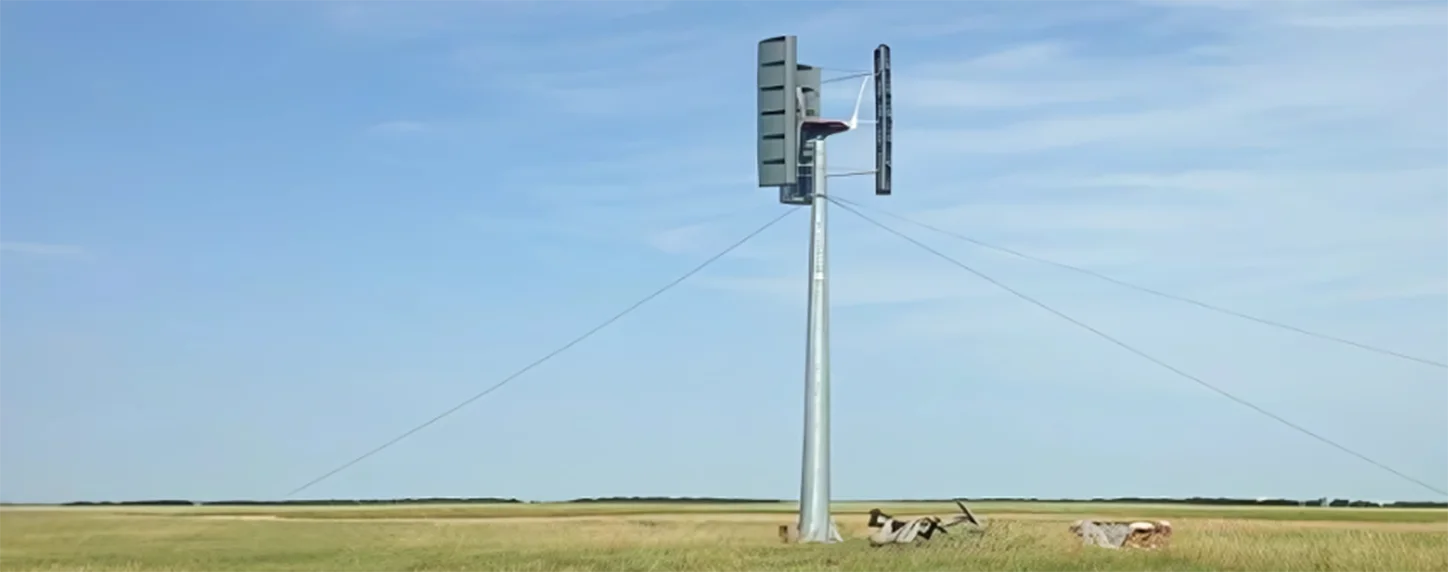
At Mundo-Power, we believe the most sustainable wind farm is the one that's already built. Our Project: Re-Wind initiative retrofits existing towers with advanced vertical-axis wind turbines (VAWTs). These turbines are compact, multi - directional, and efficient. They can be installed along the existing tower height without exceeding structural limits. Instead of a single massive turbine, the tower hosts a column of modular, high-efficiency units that, together, restore the site's productivity.
Because vertical axis wind turbines have fewer moving parts and do not require complex gearboxes, they perform reliably in extreme conditions. These systems have powered remote telecommunications infrastructure, weather stations, and coastal grids. They are ideally suited to environments like South Point, where maintenance access is limited, and weather can be punishing.
Project: Re-Wind also incorporates energy storage engineered for long-term operation. The combination of compact wind generation and robust storage turns a defunct wind site into a resilient microgrid. It's not a patch; it's a permanent renewal.
This approach respects the investment already made in a site. It reduces cost, speeds up project timelines, and avoids the reputational damage of letting infrastructure decay in place. It also delivers a cleaner energy story, one where yesterday's green investment doesn't become tomorrow's waste.
A New Chapter for Aging Wind Farms: Wind Solar Power
Kamaoa is gone now. Its towers were finally removed, its blades recycled or buried, its foundations left under pasture. But the lesson remains. If a retrofit plan had existed, Kamaoa might still be delivering energy today.
Thousands of wind farms across the U.S. and Canada are entering the same phase Kamaoa reached in 2006. The question is whether we will repeat the same outcome or choose a better path.
Project: Re-Wind offers that path. With the right strategy, we can turn aging infrastructure into a new generation of clean power. We can meet climate goals without building everything from scratch. We can prove that wind power is not just clean at the start but also built to last.