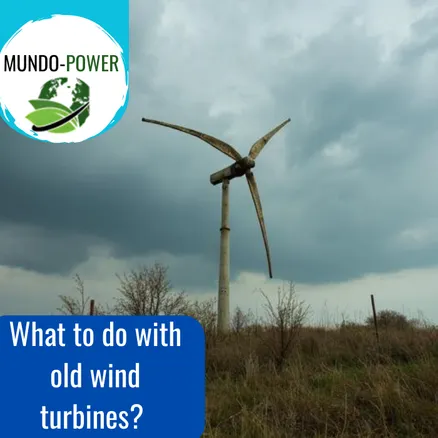
Across North America, first-generation wind projects are quietly reaching the end of their intended service lives. Turbines installed in the late 1990s and early 2000s were typically designed around a twenty-year horizon, and many are now operating on borrowed time. According to a summary of early onshore turbine design standards published by the National Renewable Energy Laboratory, the twenty-to-twenty-five-year mark is when major failures and repair costs rise sharply. The wind still blows across those ridgelines, fields, and causeway corridors, yet the machines built to harvest it are increasingly unreliable, expensive to maintain, and difficult to support with spare parts.
For the sustainability director of a large organization or a public agency responsible for a wind site, that reality does not feel abstract. It carries budget implications, ESG commitments, community expectations, and often personal accountability. Demolition can feel like a betrayal of climate goals. Letting machines stand idle invites criticism. Full rebuilds demand capital and time. The pressure to choose correctly is intense, especially when the most visible option seems to be bringing the towers down.
The Emotional Weight of an Aging Wind Site
An aging wind farm is not just a line item on an asset register. It is often a symbol of early climate leadership, a visible landmark that communities associate with clean energy and progress. When equipment begins to fail, decision-makers face questions that go far beyond capacity factors and maintenance budgets.
There is pressure from finance to avoid unplanned capital expenditures, pressure from boards or councils to keep ESG metrics on track, and pressure from neighbors who do not want to see broken turbines rusting on the horizon. Public scrutiny is high, particularly for highway and thruway projects where infrastructure is visible to thousands of drivers each day. The sense of “this was supposed to last longer” can feel personal, even if the design life has technically been met.
Recognizing that emotional context is important. It explains why demolition feels wrong, even when presented as the straightforward option. It also explains why alternatives that reuse and respect the original investment can feel intuitively right, as long as they are technically and financially sound.
What Happens When A First-Generation Wind Farm Reaches Design Life
Why older turbines cross a technical threshold
According to turbine lifetime assessments published by national laboratories, many early onshore turbines were designed for a 20-year service life. Foundations and towers were built for long-duration loads, but major components such as blades, gearboxes, and generators are typically in need of significant repair or replacement by that point. An NREL field data study reviewing more than 15 gigawatts of capacity found that main bearing failures and drivetrain issues begin to increase before the design life is technically reached, forcing owners to decide between costly repairs or retirement.
Examples that reflect the larger trend
An energy news report in Canada chronicled the retirement of a pioneering commercial wind installation after more than 2 decades of service. In the United States, a New York wind project commissioned in 2000 reached the end of its design life and scheduled a timed implosion of several turbines due to escalating repair costs and limited parts availability. These cases are becoming familiar across many regions.
Why this matters for public infrastructure
For public agencies, the stakes often feel higher. Turbines near highways, causeways, or municipal property require consideration of visibility and safety. An idle or deteriorating turbine can raise concerns and spark criticism, underscoring the need for a thoughtful, evidence-based decision.
Why Demolition Alone Rarely Aligns With ESG Goals
Full decommissioning often sounds like a straightforward reset, yet the process is complex and resource-intensive. A federal energy analysis on decommissioning practices notes that dismantling a single large onshore turbine can cost around $200,000 when crane mobilization, transport, and basic site restoration are considered. When multiplied across an entire aging wind corridor, costs escalate quickly.
What demolition actually leaves behind
Industry studies of foundation removal practices show that most decommissioning plans remove only the upper portion of the concrete footing, typically down to a shallow depth below grade, leaving the remaining mass underground. This means:
- Large volumes of concrete and rebar remain buried on site
- Soil and land use options become more constrained
- Future development may require costly excavation or avoidance
Blade disposal creates long-term ESG friction
Composite turbine blades remain one of the most challenging forms of renewable energy waste. Investigative reporting on early repowering projects documented thousands of blades being sent to landfills because large-scale composite recycling is still emerging. For organizations committed to sustainability goals, the sight of destroyed blades in landfill cells undermines the public narrative of circular, low-waste energy systems.
Demolition solves an immediate operational problem but introduces a long-lived environmental and reputational issue.
Why the Site Still Deserves A Second Life
Even when a turbine becomes uneconomical to maintain, the surrounding site usually retains significant structural and electrical value. Foundations remain structurally capable of carrying lighter loads. Tower inspections often show that the steel structure is sound. Grid interconnections, transformer pads, substations, and access roads remain intact and functional.
A federal energy infrastructure review identifies land acquisition, permitting, and interconnection approval as among the most time-consuming and expensive steps in developing a new wind project. Reusing an existing site bypasses nearly all of those hurdles. For sustainability leaders or public authorities, the preserved right-of-way is often the most valuable asset associated with an aging wind installation.
This shift from “failing turbine” to “high value infrastructure” reframes the decision. Instead of starting over, the question becomes how to extend the usefulness of what is already there.
Modular Wind Solar Power Configurations
Project: Re-Wind applies a modular approach to wind solar power, favoring multiple small, independent turbines over a single large machine. Like modern solar systems that rely on multiple panels rather than a single oversized array, this approach improves reliability, reduces downtime, and keeps energy production active even when individual units require service. The result is a more resilient way to modernize existing wind infrastructure without starting from scratch.
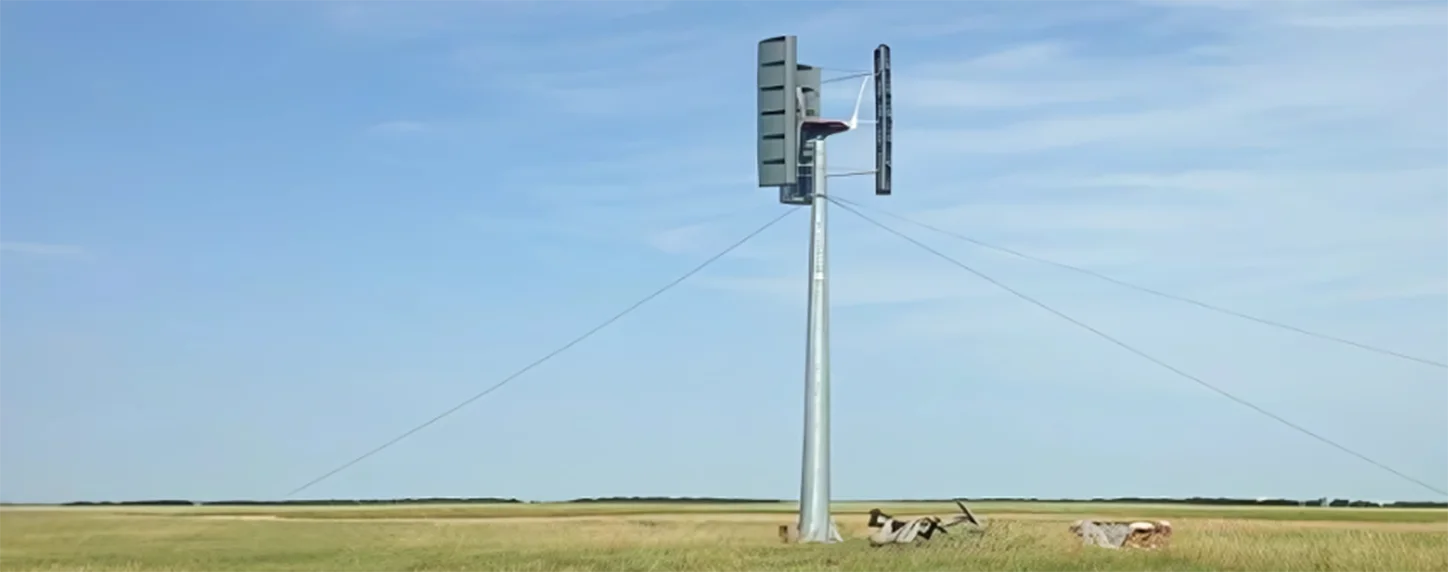
To support various tower conditions and engineering requirements, Mundo-Power offers two wind-solar power mounting configurations, both illustrated in the attachments below.
Project Re-Wind Options
- Individually Mounted Wind Solar Power Turbines
(Single vertical axis turbines mounted directly to an existing tower using clamp-on or welded brackets, allowing flexible placement and staged installation) - Ring-Mounted Wind Solar Power Turbine System
(Multi-turbine ring assembly designed to distribute loads evenly and maximize wind solar power capture around a reused tower structure)
How A Vertical Axis Wind Turbine Retrofit Reuses What Still Works

A vertical axis wind turbine retrofit turns an aging tower into the backbone of a new configuration. Instead of tearing down towers and excavating foundations, compact vertical turbines are mounted on and around the existing structure. The original horizontal rotor and nacelle are removed, and the tower becomes a support column for multiple small turbines positioned at strategic heights.
In Mundo-Power’s engineering work, these systems often include a steel ring or bracket assembly that carries several lightweight turbines operating at lower rotational speeds and accepting wind from any direction. Because each module is relatively small, lifting and installation can be completed with basic winching equipment rather than large cranes.
Conditions where a retrofit delivers strong value
- The tower passes structural inspection
- The foundation shows no major cracks or settlement
- The site has a functioning grid interconnection
- The organization wants to preserve land disturbance and avoid new concrete
From an electrical standpoint, the retrofitted tower functions as a new wind turbine system with a modular architecture that can be integrated with the existing interconnection. In some cases, a hybrid configuration integrates storage alongside the tower, creating a flexible wind-solar generator or supporting local wind-solar power without adding new structures.
This reuse-centered philosophy is expressed through Mundo-Power’s Project: Re-Wind, which applies the retrofit concept in a way that respects the original project while avoiding the environmental and financial costs of demolition.
Trust Mundo-Power for Wind Solar Power solutions.
Next Steps for Aging Wind Sites/FARMS Considering A Vertical Axis Wind Turbine Retrofit
Retiring a wind project is a visible moment in the life of a community and an organization. A retrofit using a vertical-axis wind turbine system provides a way to respect the original investment, extend the productive life of a site, and stay aligned with climate commitments tied to the land. With Project: Re-Wind, Mundo-Power applies this philosophy by transforming aging wind corridors/farms into second-generation assets rather than demolition projects.
A focused next step is commissioning structural and electrical assessments and requesting comparative modeling of demolition versus reuse. That analysis creates a grounded basis for choosing a path that supports budgets, ESG goals, and community expectations.