
Operators responsible for roadside locations are being asked to implement EV charging stations faster than infrastructure timelines realistically allow. Demand is rising, incentives are available, and expectations are changing, but grid capacity, permitting, and construction do not keep pace.
At Mundo-Power, we work with organizations that are expected to deploy EV charging stations under real-world constraints. The challenge is not whether EV charging is needed. The challenge is how to implement charging infrastructure at roadside locations where power is limited, timelines are tight, and long-term demand is still evolving.
Why roadside EV charging stations face unique infrastructure constraints
Roadside facilities, including rest areas, travel centers, and highway-adjacent sites, face conditions that differ significantly from urban or workplace EV charging stations. These sites are often located where electrical infrastructure was never designed to support high-power charging loads, and upgrading that infrastructure can take years.
Operators consistently encounter four structural challenges:
- Grid constraints, including limited available capacity and long utility upgrade timelines
- Permitting and construction delays, driven by trenching, transformer installation, and interconnection approvals
- Demand uncertainty, where EV charging station usage is difficult to predict before deployment
- Economic pressure, particularly from demand charges that complicate operating costs
Together, these factors slow EV charging station deployment precisely where fast, reliable charging is most needed.
EV charging station coverage gaps are often deployment gaps
Public discussions of EV charging station coverage often focus on maps and corridor mileage. For site operators, the gap is more practical. It exists because permanent EV charging stations take time to build.
National analysis shows that even with aggressive corridor planning, many rural and roadside areas remain underserved by EV charging stations. This is not due to a lack of interest or awareness. It is the result of infrastructure complexity, long lead times, and grid limitations that delay traditional fast-charging projects.
For operators, this creates a familiar situation. Demand exists, incentives may be available, but physical and regulatory barriers slow implementation.
Congestion increases pressure to expand EV charging station capacity
Where EV charging stations already exist, congestion introduces a different operational challenge. Peak travel periods can overwhelm even well-planned sites, leading to queues and customer dissatisfaction.
Adding permanent EV charging station capacity is not always feasible on short timelines. Utility coordination, construction schedules, and capital planning often lag behind seasonal or regional demand spikes. This leaves operators searching for ways to expand charging capacity without committing to permanent infrastructure too early.
Reliability and resilience are operational priorities.
For roadside operators, EV charging station reliability is not just a customer experience issue. It is an operational risk.
An offline EV charging station results in lost revenue, frustrated customers, and reputational damage. Grid outages, maintenance windows, and equipment failures can all interrupt service. In locations with limited charging availability, downtime has a disproportionate impact.
Reducing dependence on a single grid connection improves resilience and helps operators maintain service continuity.
The role of the off-grid EV charger in faster deployment
At Mundo-Power, we design energy solutions for environments where permanent infrastructure is constrained by time, power availability, or uncertainty.
An off-grid EV charger is not intended to replace permanent EV charging stations. It is a deployment tool that allows operators to move faster, manage risk, and maintain flexibility while long-term infrastructure catches up.
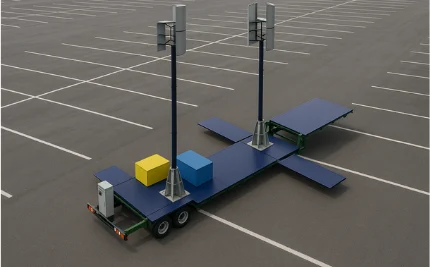
Mundo-Power’s Portable Power Trailer platform enables EV charging station deployment without waiting for trenching, transformer upgrades, or extended permitting cycles. These systems integrate onboard energy generation and battery storage to support Level 2 charging or DC fast charging, depending on configuration.
For roadside operators, an off-grid EV charger provides several practical advantages:
- Rapid EV charging station deployment where grid upgrades are delayed or unavailable
- Temporary or seasonal capacity expansion to reduce congestion during peak travel periods
- Demand validation, allowing operators to confirm EV charging station usage before permanent investment
- Resilience, maintaining charging availability during grid outages or service interruptions
- Relocation flexibility, allowing charging assets to move as traffic patterns and demand evolve
This is the practical value of an off-grid EV charger in real-world operations. It enables EV charging stations to be deployed where needed today, not years from now.
Aligning EV charging stations with operational reality
The success of roadside EV charging stations depends on aligning infrastructure decisions with how sites are developed and operated.
Permanent EV charging stations remain essential, but they are not always the fastest or most practical first step. For many operators, the ability to deploy, adjust, and scale charging capacity incrementally makes implementation achievable.
Mundo-Power approaches EV charging from this operational perspective. EV charging stations should be dependable, adaptable, and deployable on realistic timelines. When operators can add capacity quickly, manage power constraints, and respond to evolving demand, EV charging becomes an asset rather than a bottleneck.
For organizations responsible for roadside locations and other high-traffic sites, the question is no longer whether a commercial EV charging station is needed. The question is how to implement EV charging infrastructure in a way that works with today’s grid, today’s timelines, and tomorrow’s demand.